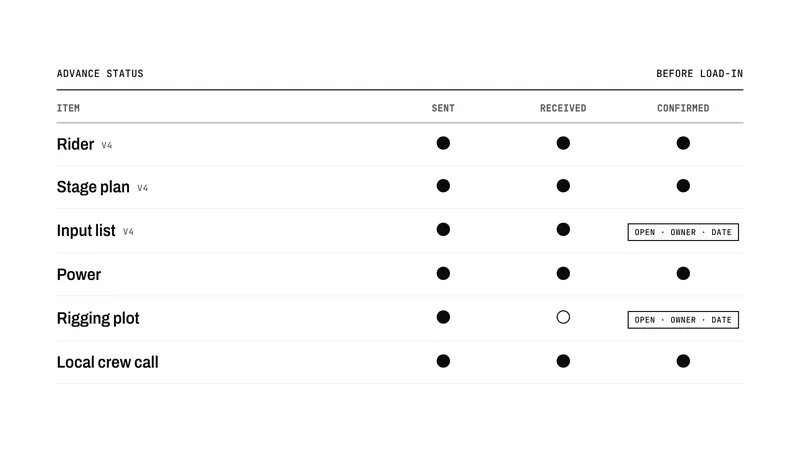
Most advances produce plenty of paper. The rider went out, the stage plan and input list went out, the venue sent its technical specification and the promoter sent a schedule. On paper, the date looks prepared.
But sending something is not the same as agreeing it. A rider that went out three weeks ago and never got a reply is not an agreement. It is an assumption, and load-in is where assumptions get tested.
Sent, received, confirmed
It helps to treat every item in an advance as being in one of three states.
Sent means you shared it. Received means the other side has it. Confirmed means the party responsible for that item has answered, either agreeing or telling you what will be different. For anything that matters on the day, that answer should be in writing.
"We've sent the venue everything" describes the first state. It says nothing about whether anyone has checked it against what they have. And a conditional or partial yes ("should be fine", "depends on the other event") is not a confirmation either. Note the condition and keep the item open.
What needs a confirmation
The exact checks depend on the production, the venue and the show, but the same five areas come up on almost every date.
The documents being worked from
Ask the venue and your local suppliers to confirm which version of the rider, stage plan, input list and rigging plot they have used. If the show has changed since the first advance, this is where an old version usually turns up.
What is provided, and what isn't
This is the core of the technical advance: PA and consoles, monitors, backline, stage dimensions, risers and stage load capacity, power (location, capacity, phase and connectors), rigging points and capacities checked against your rigging plot, barrier, and RF (local restrictions, licensing and who coordinates frequencies). Add noise limits and, for outdoor shows, weather provision.
For each item you want one of two answers: confirmed as requested, or a stated difference with an agreed alternative. "Console as per rider" is fine. So is "different console, approved by the FOH engineer, supplied and paid for by the promoter". A difference only becomes a problem when nobody has acknowledged it.
Who is responsible for what
Many problems on show day are not technical. They are gaps between the venue, the promoter, local suppliers and the touring party, where each assumes someone else has it covered. Who supplies the drum riser? Who books the runner? Is any equipment shared with the support act, and if so, on whose terms?
Write down the answer for anything that sits between two parties. If an item has no named owner, treat it as open.
Access and timings
The exact loading address, vehicle restrictions and dock access, truck and bus parking, local crew numbers and call times, doors and curfew. Confirm each one with the party that controls it, which is not always the venue. Do not copy them from an earlier date or a generic schedule. How those times depend on each other is a subject of its own; at this stage, the point is that each one has been confirmed.
People and briefings
Your team needs the names and numbers of the people they will actually deal with on the day: the venue's production contact, the local crew chief, security, and an out-of-hours number. They also need to know who can make a decision on the day if something has to change, and how credentials and access work.
Then brief your own people. A confirmation only helps if the touring party knows about it. If the venue has agreed a different console, the engineer should hear that before load-in, not at the desk.
Every open item needs an owner and a date
However good the advance, some items will still be open a few days out. That is normal. What matters is how they are handled.
For each open item, write down three things:
- Who needs to answer it.
- By when.
- What you will do if there is no answer by then.
The third point is the easiest to skip. If the monitor package has not been confirmed by the agreed date, do you bring your own, change the plan or escalate to the promoter? Deciding that in advance turns a missing answer into a planned decision rather than a surprise on the day.
Many teams keep all of this in one simple table: the item, who provides it, the answer and its date, any condition, who is following it up, the deadline and the fallback. The format matters less than the habit. Before load-in, every line should either point to a confirmation or have an owner, a deadline and a plan.
Treat silence as "not confirmed", and plan for that.
Where PréPro fits
PréPro's Pre-Production work is built around this kind of follow-through. We advance each department, check requirements against venue specifications and flag gaps and open questions clearly, working alongside your tour manager and production team.
If you have shows coming up, tell us what you're planning and we'll discuss the preparation your production needs.